
Aspheric Collimator
Aspheric lenses are designed to reduce spherical aberrations, which means they can focus the laser beam into a smaller spot size, resulting in better collimation. This is especially useful when working with high-power lasers, where tight collimation is necessary to avoid damage to the optical components.
Aspheric Collimator offer below advantages (compare with Spheric Collimator)
- Better Collimation (Smaller Beam Size)
- Improved Optical Efficiency (Less elements are needed)
- Reduce size and Weight
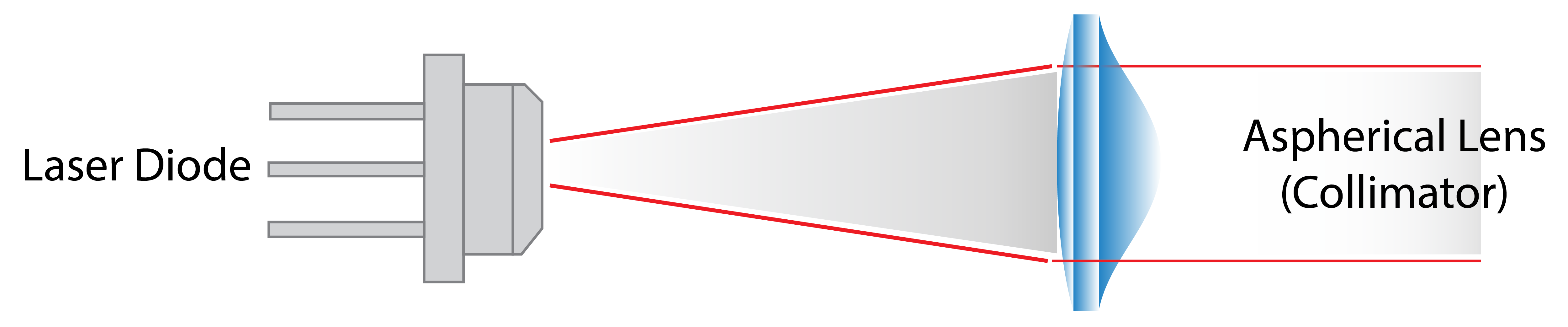

Advantages of Aspherical Lens (Collimator & Focusing)
Aspherical and spherical lenses are both commonly used in laser collimating applications. Here are some of the differences between the two types of lenses:
Aberration Correction: Aspherical lenses have a more complex surface shape than spherical lenses, which allows them to correct for aberrations that can cause distortions in the collimated laser beam. Spherical lenses, on the other hand, are limited in their ability to correct for aberrations and can introduce distortions at larger angles of incidence.
Precision and Control: Aspherical lenses can provide greater control over the shape, size, and direction of the collimated laser beam, which can be important for precision targeting and positioning. Spherical lenses, while simpler and easier to manufacture, may have limitations in their precision and control.
Power Handling: Aspherical lenses are capable of handling higher laser powers than spherical lenses due to their improved aberration correction and reduced sensitivity to thermal effects. This makes them a better choice for high-power laser collimating applications.
Compact Design: Aspherical lenses can be designed with a smaller form factor than spherical lenses, which can be important in space-constrained laser applications.

Other Components
We also provide component that used in the NdYAG laser system. You can find them below.
Cr:YAG
(A saturable absorber to generate short pulse)